A handful of people, most of them working alone with a pencil and no quantum hardware anywhere, gave quantum computing its machine and its first algorithms in little more than fifteen years. Today’s quantum chips are still built on their papers.
The godfathers of quantum computing are Paul Benioff, Richard Feynman, David Deutsch, Peter Shor, Lov Grover and Seth Lloyd. Benioff showed in 1980 that a computer could be built from a quantum system, Feynman argued in 1981 that only a quantum machine could simulate nature, and Deutsch described the universal quantum computer in 1985. Shor and Grover gave it algorithms worth running in 1994 and 1996, and Lloyd turned Feynman’s simulation idea into a theorem.
Paul Benioff. His 1980 paper showed that a Turing machine, the standard model of a computer, could in principle be built from a quantum system. He was the first to describe a computer in quantum terms.
Richard Feynman. His 1981 Endicott House talk argued that ordinary computers cannot efficiently simulate quantum systems, so the simulator should be built from quantum parts.
David Deutsch. His 1985 paper described the universal quantum computer and the first problem on which a quantum computer could beat a classical one.
Peter Shor. His 1994 algorithm factors large numbers, which threatens RSA encryption, and his 1995 nine-qubit code was the first to fix both kinds of quantum error.
Lov Grover. His 1996 algorithm finds one marked item among N in about the square root of N rounds, and no quantum algorithm can do better.
Seth Lloyd. He published an early design for a buildable quantum computer in 1993 and proved in 1996 that quantum computers can efficiently simulate local quantum systems.
- The godfathers of quantum computing at a glance
- Richard Feynman and the simulation problem
- Paul Benioff and the first quantum Turing machine
- David Deutsch and the universal quantum computer
- Peter Shor and the algorithm that made governments listen
- Lov Grover and the quantum search algorithm
- Seth Lloyd, the original quantum mechanic
- From pencil to hardware, the first quantum computers
- What the founders’ ideas became by 2026
- Yuri Manin and Alexei Kitaev, two more who could join the list
- The history of quantum computing, year by year
- Frequently asked questions
When Richard Feynman stood up at MIT’s Endicott House in May 1981 to give the keynote at a small conference on the physics of computation, nobody had agreed what a quantum computer would be, and almost the only work to describe a computer in quantum mechanical terms at all was Paul Benioff’s, whose first paper on it had appeared the year before. Within sixteen years a handful of people, nearly all of them working alone with a pencil and no quantum hardware anywhere in sight, had given the field both a theoretical machine and algorithms worth running on it, and the companies now spending billions on quantum chips are still building from their papers.
This piece looks at six of those people, the godfathers of quantum computing, with two more at the end who could just as easily have made the list. There is no single answer to who invented quantum computing, because the idea, the machine and the first algorithms came from different people. Quantum Zeitgeist has profiled most of them individually, and the links in each section lead through to those longer pieces.
The godfathers of quantum computing at a glance
The godfathers of quantum computing worked in two waves, first describing what a quantum computer would be and then finding problems it could solve faster than any ordinary machine. The table sets out who did what.
| Who | Key work | When | Why it matters |
|---|---|---|---|
| Paul Benioff | Quantum mechanical model of a Turing machine | 1980 | First description of a computer in quantum terms |
| Richard Feynman | Simulating Physics with Computers | 1981, printed 1982 | The case for quantum simulation, still a leading use |
| David Deutsch | Universal quantum computer, Deutsch’s algorithm | 1985 | The first general-purpose quantum computer and quantum speed-up |
| Peter Shor | Factoring algorithm, nine-qubit error-correcting code | 1994 and 1995 | Threat to RSA; the basis of fault-tolerant machines |
| Lov Grover | Quantum search algorithm | 1996 | Square-root speed-up for unstructured search |
| Seth Lloyd | Buildable design, universal quantum simulators, HHL | 1993, 1996, 2009 | Proved Feynman’s conjecture; root of quantum machine learning work |
| Yuri Manin and Alexei Kitaev | Quantum automata; phase estimation and the toric code | 1980; 1995 and 1997 | Manin anticipated Feynman; Kitaev’s codes led to the surface code |
Richard Feynman and the simulation problem
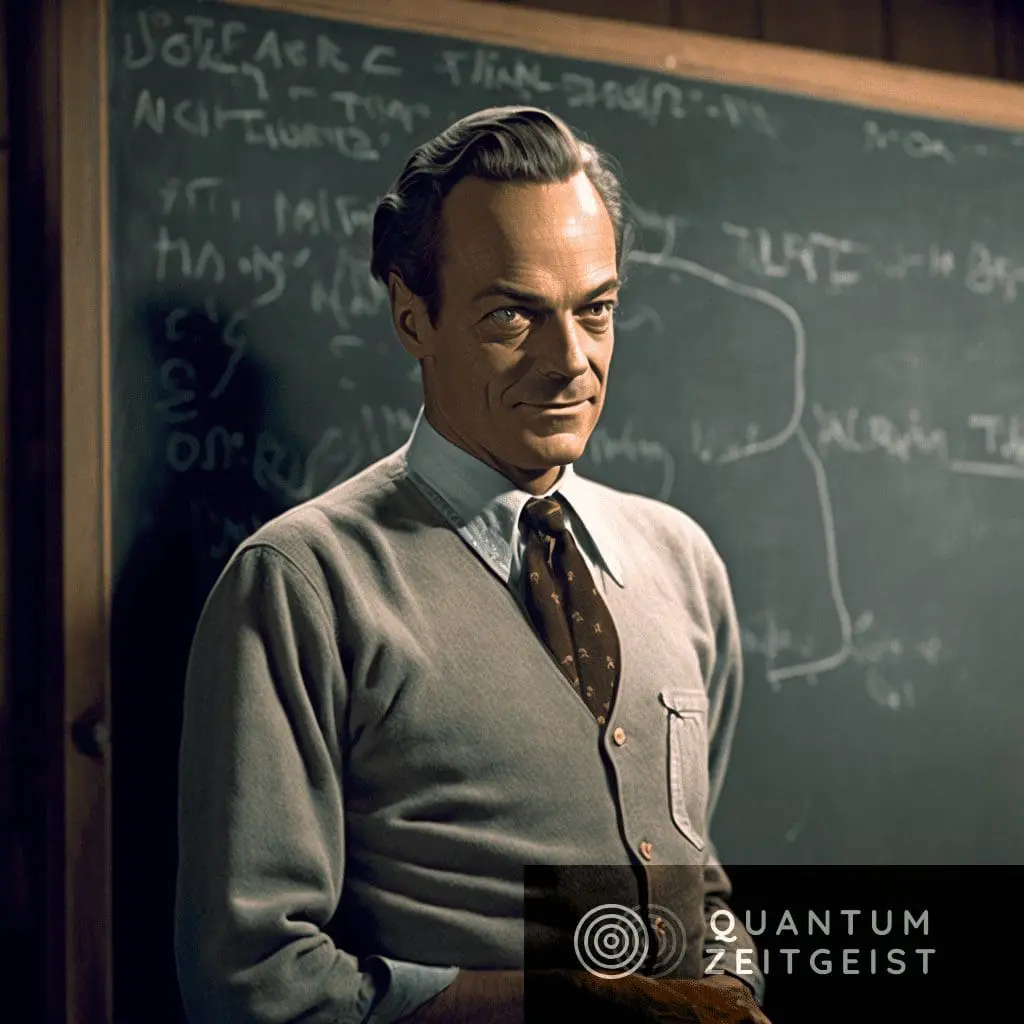
By 1981 Richard Feynman was famous well beyond physics, having shared the 1965 Nobel Prize for quantum electrodynamics, the theory of how light and charged matter interact. His Endicott House talk, published the following year in the International Journal of Theoretical Physics as “Simulating Physics with Computers”, worried away at a problem he had run into himself, which was that ordinary computers are hopeless at simulating quantum systems. The information needed to describe a collection of quantum particles doubles with every two-state particle added, so a simulation that is easy for ten particles becomes impossible for a few hundred however fast the computer is.
The meeting at which Feynman spoke was the Physics of Computation conference, jointly organised by MIT and IBM, and about 50 people made the trip to Endicott House for it. Edward Fredkin of MIT was a co-chair, and those with a long interest in the physical limits of computing included Fredkin and Tommaso Toffoli of MIT and Rolf Landauer and Charles Bennett of IBM. Feynman at first turned down the keynote, according to MIT Technology Review’s account of the meeting, and changed his mind only when promised that he could speak about whatever he wanted.
Landauer had proved in 1961 that every time a computer erases a bit of information a tiny amount of heat is produced, which tied the abstract business of computing to thermodynamics, the physics of heat and energy. Bennett, whom Landauer hired at IBM, then showed that this cost can be avoided by a computer that performs its calculations reversibly, so that every step could in principle be run backwards and nothing is ever thrown away, and Fredkin arrived at the same conclusion independently.
Bennett, who took the conference photograph, later recalled that it was here that Feynman said “Nature isn’t classical, dammit, and if you want to make a simulation of nature, you’d better make it quantum mechanical, and by golly it’s a wonderful problem, because it doesn’t look so easy.”
Feynman’s way out was to stop fighting nature and build the simulator from quantum parts, so that the machine’s own components follow the same rules as the system being studied. Quantum simulation, as the idea is now called, remains one of the strongest candidates for the first useful job a quantum computer will do, particularly in chemistry and materials science, where working out how electrons behave inside a molecule defeats classical machines.
He never wrote down a general-purpose quantum computer or an algorithm to run on one, though his 1985 paper “Quantum Mechanical Computers” showed how ordinary logic gates could be built from quantum parts, and he died in February 1988, but IBM and the International Centre for Theoretical Physics now award the ICTP-IBM Richard Feynman Prize in Quantum Computing in his name, and Quantum Zeitgeist’s profile of Richard Feynman covers his life well beyond the 1981 lecture.
Paul Benioff and the first quantum Turing machine
Paul Benioff is the name most often left out of this story, which is odd given that he was first. A physicist at Argonne National Laboratory outside Chicago, he published a paper in the Journal of Statistical Physics in 1980 showing that a Turing machine, the abstract step-by-step device Alan Turing defined in 1936 and the yardstick computer scientists use for what any computer can do, could in principle be built from a quantum system. His machine was driven by a Hamiltonian, the mathematical description of a system’s total energy that governs how it changes over time, and it could run without shedding energy as heat at every step.
Benioff followed the 1980 paper with several more, and Argonne’s obituary credits him with four papers in the early 1980s that are regarded as the first recognisable theoretical framework for a quantum computer. In June 1982 Physical Review Letters published his “Quantum Mechanical Models of Turing Machines That Dissipate No Energy”, which built such machines on a finite lattice of spin-1/2 systems, particles that behave like tiny magnets that can point only up or down. That November the Journal of Statistical Physics carried a much longer treatment, “Quantum mechanical Hamiltonian models of Turing machines”, which ran to more than 30 pages.
That mattered because physicists through the 1970s had seriously wondered whether quantum uncertainty made reliable computation at the scale of atoms impossible, and Benioff showed that it did not. His machine used quantum mechanics to compute but gained no speed from doing so, which goes a long way to explaining why Feynman and Deutsch, both of whom built on his work, are better remembered today.
He spoke at the same Endicott House meeting as Feynman, kept publishing on quantum computation and the foundations of physics from Argonne for decades afterwards, and died in March 2022. Quantum Zeitgeist’s profile of Paul Benioff tells the story of the 1980 paper in more detail.
None of this was part of his job. Benioff earned a Berkeley doctorate in nuclear chemistry in 1959 and joined Argonne in 1961 to work in chemistry and environmental sciences, and according to the laboratory’s obituary he did his quantum research in his spare time. Stephen Gray, a senior chemist at Argonne, recalled that in the 1990s Benioff was exploring “quantum robots” for carrying out experiments, an idea Gray suggested was perhaps a precursor to quantum sensing, the use of quantum systems as extremely sensitive measuring instruments.
Formal recognition came two decades after the first paper. In 2000 he received the Quantum Communication Award of the International Organization for Quantum Communication, Computing and Measurement and the Quantum Computing and Communication Prize from Tamagawa University in Japan, and he became a fellow of the American Physical Society in 2001. Argonne held a conference in honour of his quantum computing work in 2016.
David Deutsch and the universal quantum computer
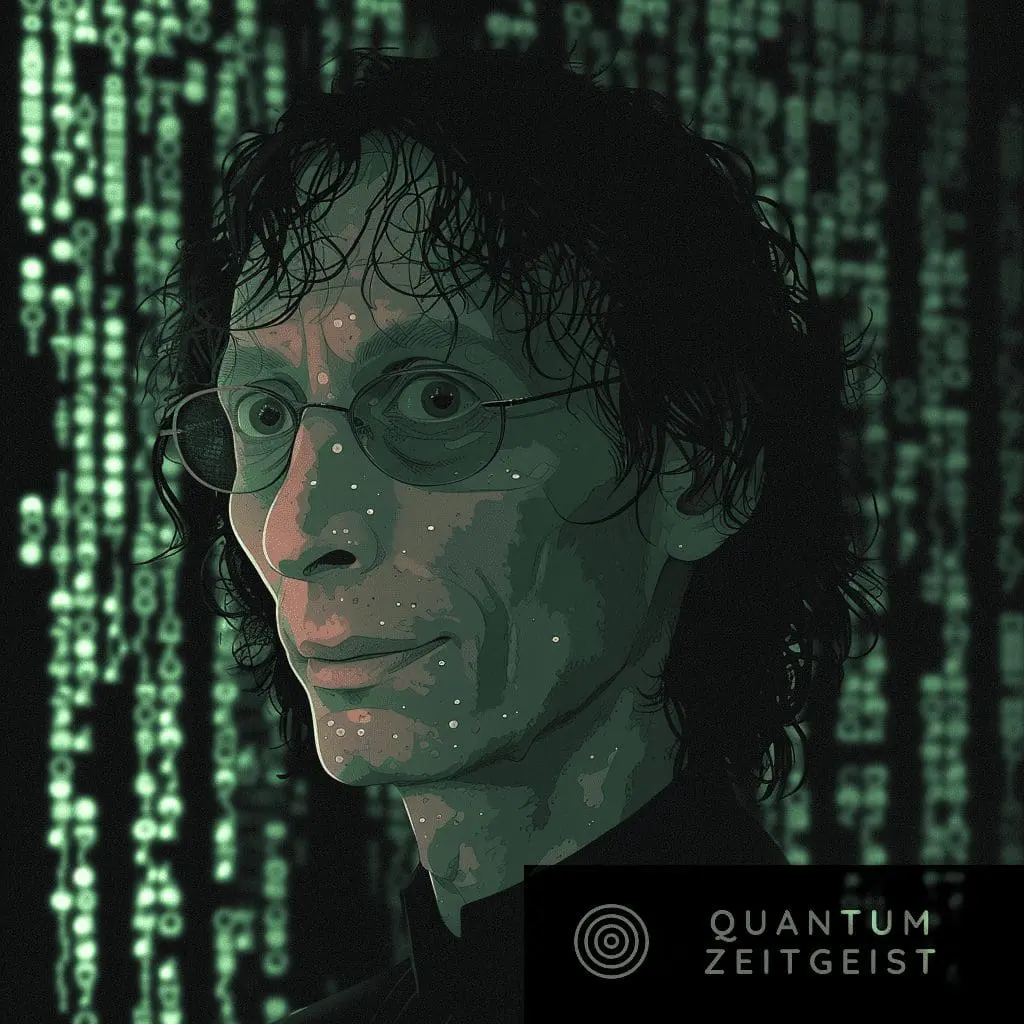
David Deutsch was born in Haifa in 1953, grew up in London and studied at Cambridge and Oxford, and after a spell at the University of Texas at Austin he went back to Oxford, where he wrote the 1985 paper that gave quantum computing its theoretical machine.
Published in the Proceedings of the Royal Society as “Quantum theory, the Church-Turing principle and the universal quantum computer”, it took the old idea that any reasonable computer can imitate any other and recast it as a law of physics, holding that every finitely realisable physical system can be perfectly simulated by a universal machine operating by finite means. Deutsch argued that classical physics and the classical Turing machine fail that standard while quantum theory and a quantum computer can meet it, and his universal quantum computer, a machine able in principle to simulate any physical process, was the first description of a general-purpose quantum computer.
Tucked into the same paper was the first problem a quantum computer could solve in fewer steps than a classical one. Deutsch’s algorithm asks whether a simple one-bit function gives the same answer for both of its possible inputs, and with a single look at the function, where any classical method needs two, it settles the question half the time and otherwise reports that it has failed. In 1992 he and Richard Jozsa stretched the idea into the Deutsch-Jozsa algorithm, which takes a function of many bits that is promised to be either constant or evenly balanced and tells which with certainty using two queries, where a deterministic classical approach can need exponentially many.
A 1998 refinement cut both algorithms to a single query. Nobody needed either problem solved, but these toy results were the first hard evidence that a quantum machine could beat a classical one at anything, if only against classical methods that must be certain of the answer. The line of work they began ran through Ethan Bernstein and Umesh Vazirani in 1993 and Daniel Simon in 1994, whose algorithm Shor credits as his inspiration, to Shor’s algorithm in 1994.
Between the universal machine and the Deutsch-Jozsa algorithm, Deutsch also supplied the parts from which such a machine could be assembled. His 1989 paper in the Proceedings of the Royal Society, “Quantum computational networks”, described quantum gates as the generalisation of the logic gates inside ordinary computers and quantum networks as the generalisation of their circuits, and showed that a single type of universal quantum gate, joined by quantum wires, is enough to build a network with any possible quantum computational property. Programs for today’s quantum processors are still written as circuits of gates in this way, and IBM’s documentation for Qiskit, its quantum programming toolkit, states that “The fundamental element of quantum computing is the quantum circuit.”
Deutsch has always argued that his computing work only makes full sense under the many-worlds interpretation of quantum mechanics, the view that every possible outcome of a quantum measurement happens in its own branch of reality, and he made that case for general readers in The Fabric of Reality in 1997 and The Beginning of Infinity in 2011.
He has been a visiting professor of physics at Oxford since 1999 and was a founder member of its Centre for Quantum Computation, and more recently he has been developing constructor theory with Chiara Marletto, an attempt to describe physical laws purely in terms of which transformations are possible and which are not. He shared the 2023 Breakthrough Prize in Fundamental Physics with Charles Bennett, Gilles Brassard and Peter Shor, and Quantum Zeitgeist’s profile of David Deutsch goes further into both the physics and the philosophy.
Peter Shor and the algorithm that made governments listen
Peter Shor was a mathematician at AT&T Bell Laboratories in New Jersey, with a doctorate from MIT and a background in combinatorics, when he presented a quantum algorithm for factoring large numbers at the IEEE Symposium on Foundations of Computer Science in November 1994. Factoring means breaking a number down into the primes that multiply to give it, and because the best classical methods slow down dramatically as numbers grow, the RSA encryption that protects much of the internet depends on factoring numbers hundreds of digits long being impractical.
Shor turned factoring into the problem of finding the period of a repeating mathematical function and then used the quantum Fourier transform, a quantum version of the technique that splits a signal into its component frequencies, to find that period efficiently, and the same approach also breaks the discrete logarithm problem that elliptic-curve cryptography relies on.
Shor’s own route to the algorithm ran through the two papers that came just before it. Ethan Bernstein and Umesh Vazirani’s “Quantum complexity theory”, presented in 1993 and expanded in the SIAM Journal on Computing in 1997, studied quantum computers through complexity theory, the branch of computer science that sorts problems by how much time and memory they need. The journal version defines BQP, the class of problems a quantum computer can solve efficiently with only a small chance of error, and gives the first formal evidence that quantum machines can far outpace classical ones that make random choices, on a problem posed through an oracle, a black box that answers questions about a hidden function.
Shor heard Vazirani describe that work at Bell Labs in 1992 and was not satisfied with what he saw as a rather contrived problem, so he began looking for a real one that a quantum computer could solve faster.
Daniel Simon then found a problem, telling apart two kinds of function, that a quantum computer can provably solve exponentially faster than any classical method relying on chance, and Shor argued for the paper on the 1994 STOC programme committee, which rejected it, before it appeared at FOCS later that year. Simon’s algorithm used a Fourier transform to find the period of a function, and because Shor knew that the discrete logarithm problem was tied to periodicity, he set out to do the same for it.
Shor told the rest of the story in his 2022 retrospective, “The Early Days of Quantum Computation”, first prepared for the 40th anniversary of the Endicott House meeting. He solved the discrete logarithm problem in April 1994 and told only a few people, among them his boss David Johnson and his Bell Labs colleague Jeff Lagarias, who checked the algorithm and found a small error that was easily fixed. He then presented it at Henry Landau’s Tuesday seminar at Bell Labs, whose audience interrupted so often that one speaker never got past his second slide, and later that week he found the factoring algorithm as well.
That weekend, at home with a bad cold, Shor took a call from Umesh Vazirani, who said “I hear that you can factor efficiently with a quantum computer.” The rumour of a talk on discrete logarithms had turned into factoring on its way to Vazirani, but Shor had solved factoring in the meantime and could explain it, and as he put it, “After that, the news spread like wildfire.”
Vazirani presented the algorithm at a Santa Fe Institute conference in May that Shor could not attend, Artur Ekert spoke about it to physicists at an atomic physics conference in Boulder that August, and NIST arranged a meeting on quantum computation in Gaithersburg, Maryland, the same month because of the discovery. It was at Santa Fe, Shor recalled, that Rolf Landauer had already raised the big objection, which was that quantum computers did not look as though they could be made fault tolerant, able to keep working correctly when their parts make errors.
Within a year or two quantum computing had gone from a physicist’s curiosity to a question of national security, and the long official response to Shor’s paper eventually produced the post-quantum cryptography standards that the US National Institute of Standards and Technology published in August 2024. Plenty of physicists still doubted that the machine could ever be built, because the qubit, the quantum counterpart of a bit that can hold a combination of 0 and 1 until it is measured, is so sensitive to stray heat and electromagnetic noise that it loses its information in a fraction of a second.
Shor answered them himself in 1995 with the first quantum error-correcting code able to fix both kinds of quantum error, flipped bits and flipped phases, which spreads one logical qubit, the reliable qubit a programmer works with, across nine physical qubits so that an error on any one of them can be found and fixed without measuring, and so destroying, what is stored.
His 1996 work on fault-tolerant quantum computation showed how to calculate on encoded qubits without errors spreading out of control, a result others soon extended to calculations of any length, and that line of work, together with Kitaev’s toric code, leads to the surface code, a scheme that arranges qubits on a flat grid and constantly checks small neighbouring groups of them for errors, which Google ran on its Willow chip in late 2024 to show logical errors falling as the code grew larger, as Quantum Zeitgeist’s guide to the surface code explains.
Shor won the Nevanlinna Prize in 1998 and the Gödel Prize in 1999, and he is now the Morss Professor of Applied Mathematics at MIT, with his story told in Quantum Zeitgeist’s profile of Peter Shor and its history of Shor’s algorithm.
Lov Grover and the quantum search algorithm
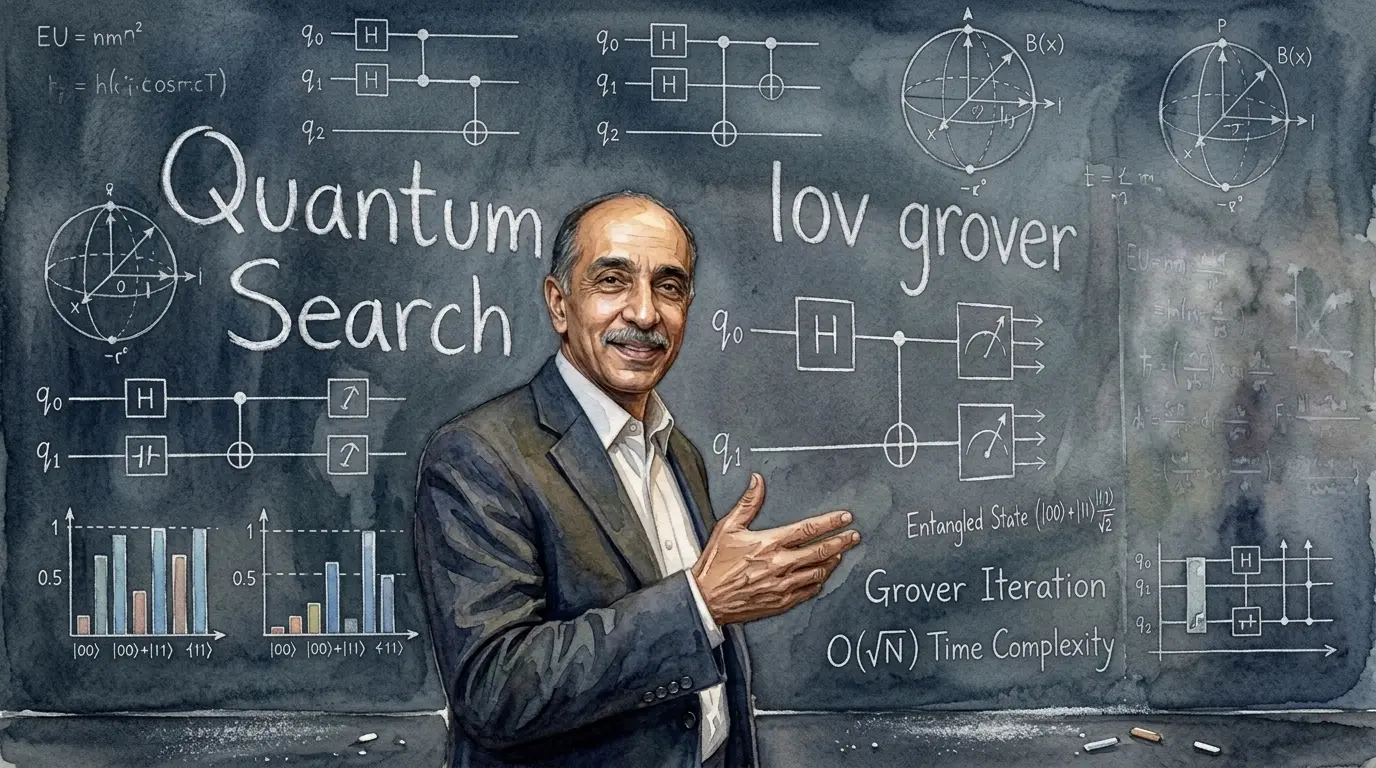
Lov Grover was born in Meerut in northern India in 1961, took his first degree at the Indian Institute of Technology Delhi and a PhD in electrical engineering at Stanford, and joined Bell Labs in 1984, returning in 1994 after seven years teaching at Cornell, so by the mid-1990s he and Shor were working for the same company.
His 1996 paper at the ACM Symposium on Theory of Computing, “A fast quantum mechanical algorithm for database search”, tackled unstructured search, the job of finding one marked entry in a list of N items when nothing about the order of the list gives the answer away, so that a classical computer has to check entries one by one and needs about N/2 tries on average. Grover’s algorithm needs only about the square root of N rounds, which means a list of a million entries takes fewer than a thousand rounds where a classical search would expect half a million checks.
The technique underneath, now called amplitude amplification, starts every candidate answer with the same amplitude, the quantity whose square gives the probability of getting that answer when the qubits are measured. Each round flips the sign of the marked answer’s amplitude and then reflects every amplitude about the average, and repeating those two steps drains probability away from the wrong answers and piles it onto the right one until a measurement will almost certainly return it.
Charles Bennett, Ethan Bernstein, Gilles Brassard and Umesh Vazirani proved in 1997 that no quantum algorithm can search an unstructured list any faster, which makes Grover’s method optimal, and while a square-root speed-up looks modest next to what Shor found for factoring, it applies to a far wider range of problems.
That breadth is why cryptographers recommend longer keys for symmetric ciphers such as AES, the Advanced Encryption Standard used to encrypt stored data and network traffic, since a square-root speed-up in principle halves the effective length of a key in bits, so a 128-bit key offers only about 64 bits of security against such an attack. Grover has kept a foot in industry as well, and in 2023 the AIM-listed Quantum Blockchain Technologies retained him as a consultant to assess its quantum version of SHA-256, the hashing algorithm at the heart of Bitcoin mining. Quantum Zeitgeist’s profile of Lov Grover and its guide to Grover’s search algorithm go into the mathematics in more depth.
Seth Lloyd, the original quantum mechanic

Seth Lloyd likes to call himself a quantum mechanic, which is a fair description of a career spent working out how quantum computers might be assembled and what they could do once they were. Born in 1960, he studied physics at Harvard and then mathematics and the history and philosophy of science at Cambridge, completed his Rockefeller University doctorate in 1988 under Heinz Pagels and spent three years at Caltech working with Murray Gell-Mann and three more at Los Alamos National Laboratory before moving to MIT in 1994, where he is a professor of mechanical engineering and directs the Center for Extreme Quantum Information Theory.
In 1993 he published in Science what is widely regarded as the first technologically feasible design for a quantum computer, an array of weakly coupled quantum systems controlled by a sequence of electromagnetic pulses of well-defined frequency and length.
Three years later Lloyd closed the question Feynman had left open in 1981. His 1996 Science paper on universal quantum simulators proved that a quantum computer could efficiently simulate any physical system whose parts interact only locally, a few at a time, which turned Feynman’s conjecture into a theorem and put quantum simulation on solid mathematical ground.
In 2009 he, Aram Harrow and Avinatan Hassidim published the HHL algorithm, a method for preparing a quantum state that encodes the solution of a very large system of linear equations exponentially faster than classical methods, provided the equations are sparse and well behaved and only summary properties of the solution are needed, and it became the starting point for a great deal of today’s work on quantum machine learning.
Lloyd’s other result from the mid-1990s mattered most to the people trying to build the hardware. His 1995 paper in Physical Review Letters, “Almost any quantum logic gate is universal”, showed that almost any quantum logic gate with two or more inputs is computationally universal, meaning that nearly any controllable interaction between qubits, applied a few qubits at a time in the right sequence, can be built up into any quantum computation at all. Deutsch, Barenco and Ekert published the same finding in the Proceedings of the Royal Society a month earlier, and together the two papers left experimenters free to work with whatever two-qubit interaction their hardware offered rather than having to engineer one particular gate.
His 2006 book Programming the Universe argues that the universe is itself a quantum computer working through its own program, an idea he has defended in lectures ever since. Quantum Zeitgeist has written about him in its profile of Seth Lloyd and in a piece on Lloyd and the HHL algorithm.
From pencil to hardware, the first quantum computers
Quantum computing became an experimental science within months of Shor’s factoring paper. In May 1995 Ignacio Cirac and Peter Zoller of the University of Innsbruck published a proposal in Physical Review Letters for a quantum computer built from ions, atoms carrying an electric charge, held in a line inside a trap and addressed with laser beams. Their key idea was to couple each ion’s internal state to the motion the ions share, using it as a data bus so that a gate could act on any pair of ions in the string.
Seven months later Christopher Monroe, David Wineland and their colleagues at the National Institute of Standards and Technology in Boulder, Colorado, reported in the same journal a working controlled-NOT gate, which flips one qubit only when a second, controlling qubit is set to 1. Their two qubits were stored in a single laser-cooled atom, one in its internal state and one in its motion in the trap, and together with simple single-qubit operations the controlled-NOT forms a universal set for quantum computation. Wineland shared the 2012 Nobel Prize in Physics with Serge Haroche for experimental methods that make it possible to measure and manipulate individual quantum systems.
Running a whole algorithm took another three years and a different technology, nuclear magnetic resonance or NMR, in which the spins of atomic nuclei inside molecules act as qubits, are programmed with radio-frequency pulses and are read out by instruments similar to those used in hospitals and chemistry labs. In 1998 Jonathan Jones and Michele Mosca at Oxford used an NMR quantum computer based on the molecule cytosine to solve Deutsch’s problem, the one-bit puzzle from his 1985 paper. That April, Isaac Chuang of IBM’s Almaden Research Center, Neil Gershenfeld of the MIT Media Lab and Mark Kubinec of the University of California, Berkeley reported running Grover’s search algorithm on a four-state system using a chloroform solution.
The same approach produced what IBM called the first demonstration of Shor’s algorithm, when a team of IBM scientists and Stanford University graduate students led by Chuang reported in Nature in December 2001 that they had factored 15 into 3 and 5. The simplest meaningful instance of Shor’s algorithm needs seven qubits, so IBM chemists designed a new molecule with seven nuclear spins, belonging to five fluorine and two carbon atoms, and the team ran the calculation on a vial of a billion billion of them. “Now we have the challenge of turning quantum computation into an engineering reality,” said Chuang, who had by then become an associate professor at MIT.
The engineering problem was that liquid NMR would not grow, since IBM itself said it would be very difficult to make molecules with many more than seven qubits, and its 2001 announcement named electron spins in semiconductors, single-atom impurities and superconductors among the strong candidates to take over.
The superconducting route had opened two years earlier, when Yasunobu Nakamura and Jaw-Shen Tsai of NEC’s Fundamental Research Laboratories in Japan, with Yuri Pashkin of the Japan Science and Technology Corporation, reported in Nature on a single-Cooper-pair box, a tiny superconducting electrode joined to a reservoir through a Josephson junction, a thin barrier through which pairs of superconducting electrons can tunnel. The device behaved as an artificial two-level system that could be held in a superposition of two charge states and steered with a short voltage pulse, which the authors described as electrical coherent control of a qubit in a solid-state electronic device.
None of these early machines could compute anything that pencil and paper could not, but between them they showed that the gates Deutsch described, the universality Lloyd and others proved and the algorithms of Deutsch, Grover and Shor could each be made to work on real atoms and circuits. The theorists had worked without any hardware for fifteen years, and within seven years of Shor’s paper the hardware had caught up with the simplest of their ideas.
What the founders’ ideas became by 2026
The clearest line from the godfathers of quantum computing to the present runs through error correction. In a Nature paper published on 9 December 2024 alongside its Willow chip, Google reported that each increase in surface code distance, a measure of how many simultaneous errors the code can withstand, cut the logical error rate by a factor of about 2.14, and that its largest code, built from 101 qubits, held information 2.4 times as long as the chip’s best single physical qubit. Hartmut Neven, the founder of Google Quantum AI, wrote that driving errors down while adding qubits had been an outstanding challenge “since quantum error correction was introduced by Peter Shor in 1995.”
Shor’s algorithm has meanwhile become much cheaper on paper. In May 2025 Craig Gidney of Google Quantum AI estimated that a 2048-bit RSA number could be factored in less than a week by a quantum computer with fewer than a million noisy qubits, the error-prone physical qubits that real hardware provides, down from the 20 million he had estimated in 2019 with his co-author Ekerå. The estimate rests on stated assumptions, among them a square grid of qubits linked only to their nearest neighbours and a gate error rate of 0.1 per cent, and Gidney presented it as an input to planning the move to quantum-safe cryptography.
The three standards NIST published on 13 August 2024 to support that move are FIPS 203, built on an algorithm now called ML-KEM for general encryption, and FIPS 204 and FIPS 205 for digital signatures, the electronic fingerprints that confirm who sent a message. In March 2025 NIST chose a fifth algorithm, HQC, as a backup to ML-KEM with a final standard expected in 2027, and HQC is built on classical error-correcting codes, the same family Shor borrowed from when he designed codes to protect qubits.
The physics behind superconducting qubits, one of the routes being explored towards a quantum computer, won the Nobel Prize in Physics on 7 October 2025, when John Clarke, Michel Devoret and John Martinis were honoured “for the discovery of macroscopic quantum mechanical tunnelling and energy quantisation in an electric circuit”. In experiments at the University of California, Berkeley, in 1984 and 1985 they showed that a superconducting circuit with a Josephson junction could tunnel through an energy barrier it could not classically cross and could absorb or emit energy only in fixed amounts.
The academy notes that Martinis later used exactly that quantisation to build a qubit, with the circuit’s lowest energy state as zero and the next one up as one, and Devoret is now chief scientist for quantum hardware at Google Quantum AI.
Feynman’s simulation problem remains one of the strongest candidates for the first useful results, and it is also where claims need the most care. On 22 October 2025 Google reported in Nature an algorithm it calls Quantum Echoes, which runs a sequence of operations forwards, disturbs one qubit and runs the sequence backwards to see how the disturbance has spread, and said it ran 13,000 times faster on Willow than the best classical method on one of the world’s fastest supercomputers. Thomas O’Brien, a staff research scientist at Google Quantum AI, told IEEE Spectrum that a companion experiment applying the method to two small molecules, of 15 and 28 atoms, gave results that “aren’t beyond classical yet”.
Yuri Manin and Alexei Kitaev, two more who could join the list
Yuri Manin, a mathematician at the Steklov Institute in Moscow, made a point very close to Feynman’s a year before him in his 1980 Russian-language book Computable and Uncomputable, where he suggested that a computer built from quantum automata, machines whose internal states follow quantum rules, might model quantum systems that classical machines cannot. Hardly anyone outside the Soviet Union read it at the time, which is why Manin rarely appears in Western histories of the field, and he is far better known for algebraic geometry and number theory, work he continued at the Max Planck Institute for Mathematics in Bonn until his death in January 2023.
Alexei Kitaev, a theoretical physicist then at the Landau Institute near Moscow, published the quantum phase estimation algorithm in 1995, a general method for reading off the phase, the quantity describing where a quantum state sits in its cycle of oscillation, that a quantum operation applies to a state it otherwise leaves unchanged, and it now sits inside Shor’s algorithm and many quantum chemistry methods. In 1997 he proposed the toric code, an error-correcting code laid out on a grid wrapped round into a doughnut shape, and with it topological quantum computation, in which information is stored in the collective behaviour of anyons, particle-like excitations that exist only in certain two-dimensional systems, so that local noise struggles to disturb it.
Also in 1997, Kitaev outlined in a review paper a proof of what is now called the Solovay-Kitaev theorem, which Solovay had announced for single qubits on an email discussion list in 1995 without ever publishing a paper. The theorem says that if a small set of gates can get arbitrarily close to any single-qubit operation, then short sequences of those gates can approximate any desired gate to high accuracy. That matters because an error-corrected machine can usually perform only a limited number of gates directly and has to build everything else out of them, including the fine rotations that Shor’s algorithm uses.
The surface code Google ran on Willow is the flat, practical descendant of the toric code, and Kitaev, a researcher at Microsoft Research from 1999 to 2001, was among the researchers who helped build up Microsoft’s quantum computing groups, according to a 2016 interview with Microsoft’s Alex Bocharov republished by Scientific American. That programme produced the Majorana 1 chip in February 2025, which Microsoft says holds eight topological qubits and whose claims have drawn sustained scepticism from other physicists. Kitaev is now a professor at Caltech, and he won a MacArthur Fellowship in 2008 and one of the first Breakthrough Prizes in Fundamental Physics in 2012.
The history of quantum computing, year by year
| Year | What happened |
|---|---|
| 1980 | Benioff publishes a quantum mechanical model of a Turing machine; Manin’s book Computable and Uncomputable |
| 1961 | Landauer shows that erasing a bit of information costs a minimum amount of heat |
| 1981 | Feynman’s keynote at the Physics of Computation conference at MIT’s Endicott House |
| 1982 | Simulating Physics with Computers published; Benioff’s Turing machines that dissipate no energy in Physical Review Letters |
| 1985 | Deutsch describes the universal quantum computer and Deutsch’s algorithm; Feynman’s Quantum Mechanical Computers |
| 1992 | Deutsch and Jozsa publish the Deutsch-Jozsa algorithm |
| 1993 | Lloyd publishes a design for a buildable quantum computer in Science |
| 1994 | Shor solves discrete logarithms in April and factoring days later; news spreads from a Bell Labs seminar |
| 1995 | Shor’s nine-qubit code; Kitaev’s phase estimation; Cirac and Zoller’s ion-trap proposal and the first two-qubit gate at NIST |
| 1996 | Grover’s search algorithm; Lloyd’s universal quantum simulators; Shor on fault tolerance |
| 1997 | Kitaev proposes the toric code; Grover’s algorithm proved optimal |
| 1998 | Two-qubit NMR machines run Deutsch’s problem and Grover’s search |
| 1999 | Nakamura, Pashkin and Tsai demonstrate a superconducting qubit |
| 2001 | IBM and Stanford factor 15 with Shor’s algorithm on a seven-qubit NMR machine |
| 2000 | Benioff receives the Quantum Communication Award and the Tamagawa University prize |
| 2009 | Harrow, Hassidim and Lloyd publish the HHL algorithm |
| 2023 | Deutsch shares the Breakthrough Prize in Fundamental Physics with Bennett, Brassard and Shor |
| 2024 | NIST publishes its first post-quantum standards; Google’s Willow chip runs the surface code |
| 2025 | Microsoft announces Majorana 1; NIST picks HQC; Gidney puts RSA-2048 within reach of under a million noisy qubits; Nobel Prize for Clarke, Devoret and Martinis; Google’s Quantum Echoes |
The godfathers of AI, Hinton, Bengio and LeCun
The godfathers of quantum cryptography
David Deutsch, the father of quantum computing
The history of quantum computing
Frequently asked questions
Who are the godfathers of quantum computing?
Paul Benioff, Richard Feynman, David Deutsch, Peter Shor, Lov Grover and Seth Lloyd. Yuri Manin and Alexei Kitaev have a strong claim to join them.
Who invented quantum computing?
No single person. Paul Benioff published the first quantum mechanical model of a computer in 1980, Richard Feynman argued for quantum simulators in 1981, and David Deutsch described the universal quantum computer in 1985.
Who is the father of quantum computing?
David Deutsch is the person most often given the title, because his 1985 paper described the first general-purpose quantum computer. Feynman and Benioff are also named as founders, since their work came first.
What did Richard Feynman say about quantum computers?
In a 1981 talk, published in 1982 as Simulating Physics with Computers, he argued that ordinary computers cannot efficiently simulate quantum systems. He proposed building the simulator from quantum parts instead.
When was the first quantum computer built?
The first working two-qubit logic gate was demonstrated at NIST in 1995. In 1998 two-qubit NMR machines ran Deutsch’s problem and Grover’s search, and in 2001 IBM and Stanford used a seven-qubit NMR machine to factor 15 with Shor’s algorithm.
What was the first quantum algorithm?
Deutsch’s algorithm, in his 1985 paper. It asks whether a one-bit function gives the same answer for both inputs using a single look at the function, where a classical method needs two. The original version succeeded half the time, and a 1998 refinement made it certain.
What is Shor’s algorithm?
A quantum algorithm for factoring large numbers, presented by Peter Shor in 1994. It turns factoring into finding the period of a repeating function, which a quantum Fourier transform does efficiently, and it threatens RSA encryption.
What is Grover’s algorithm?
A quantum search algorithm published by Lov Grover in 1996. It finds one marked item in an unsorted list of N items in about the square root of N rounds, and no quantum algorithm can do better.
Who invented quantum error correction?
Asher Peres described a code against flipped bits in 1985, and Peter Shor published the first code that fixes both kinds of quantum error, flipped bits and flipped phases, in 1995. Shor’s code spreads one logical qubit across nine physical qubits so that an error on any one of them can be found and fixed.


See today’s quantum computing news on Quantum Zeitgeist for the latest breakthroughs in qubits, hardware, algorithms, and industry deals.